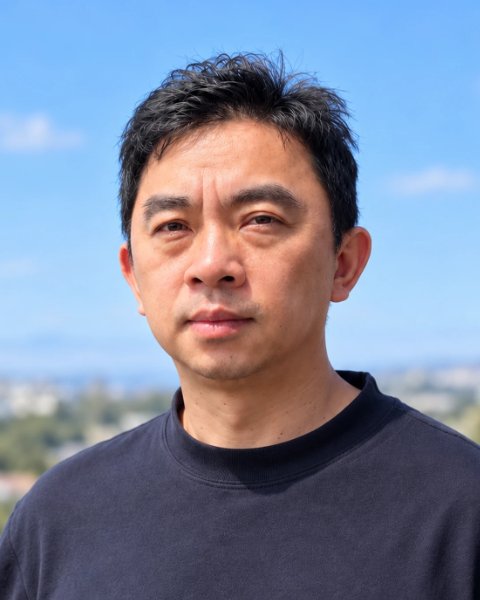
Min JIANG江敏
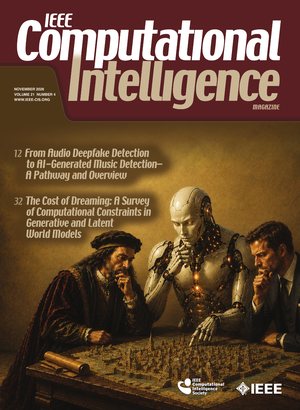 Latest · CIM 21(4)
Agents Act. Who Decides?
“There is only one heroism in the world: to see the world as it is, and to love it.”
人生只有一种英雄主义,那就是认清生活的真相后,仍然热爱生活。
— Romain Rolland, Vie de Michel-Ange
About
Min JIANG is a Professor in the Department of Artificial Intelligence, School of Informatics, Xiamen University, and head of the Machine Evolution and Learning Lab. The lab works on evolutionary computation, learning-driven optimization and AI for Science, asking how intelligent systems can adapt, reason and support decisions in complex environments.
Jiang is Editor-in-Chief of IEEE Computational Intelligence Magazine (2026– ) and an Associate Editor of IEEE Transactions on Evolutionary Computation, and serves as Area Chair for ICML 2027, NeurIPS 2026 and IJCAI 2024 and Senior Program Committee member for IJCAI 2027. A 2018 paper in IEEE TEVC brought transfer learning into dynamic multiobjective optimization, and a survey of evolutionary transfer optimization written with collaborators received the 2024 IEEE CIM Outstanding Paper Award. Jiang has been listed among the World's Top 2% Scientists (Stanford University & Elsevier) every year from 2023 to 2026.
Jiang received the B.S. (2001) and Ph.D. (2007) degrees in Computer Science from Wuhan University and was a visiting researcher in the Department of Computer Science, City University of Hong Kong, from 2005 to 2007. Jiang is a Senior Member of IEEE.
Research
- Learning-driven evolutionary optimizationBringing transfer learning, pre-training and large language models into evolutionary search for dynamic, large-scale and bilevel optimization.
- Neuro-symbolic knowledge discovery and multiphysics simulationSymbolic regression, physics-embedded networks and neural operators for modeling and simulating coupled systems.
- AI for ScienceInterpretable solvers for partial differential equations, differentiable modeling, and learning physical laws from observations.
Editor's Remarks
- 21(4)2026.11Agents Act. Who Decides?IEEE CIM 21(4) · Nov 2026 · IEEE XploreCoverAdapted from Moritz Retzsch's Die Schachspieler (The Chess Players, Germany, 1831), also known as Checkmate. In the original, a young man plays the Devil with his soul at stake; legend has it that the chess master Paul Morphy studied the painting and declared, “The king has one more move.” The cover gathers an old master, an AI and a person of today around a chessboard city: agents can already make moves, but whether a move should be made still takes judgment.
 21(3)2026.08Models Speak. Agents Act.IEEE CIM 21(3) · Aug 2026 · Full text · IEEE XploreCoverAdapted from Caspar David Friedrich's Wanderer above the Sea of Fog (Germany, 1818, oil on canvas, 94.8 × 74.8 cm, Hamburger Kunsthalle). The original shows a traveler on a summit above a sea of fog; the cover replaces the fog with a city of intelligence coming alight. Models can speak and agents have begun to act, so those who stand high must see the road ahead all the more clearly.
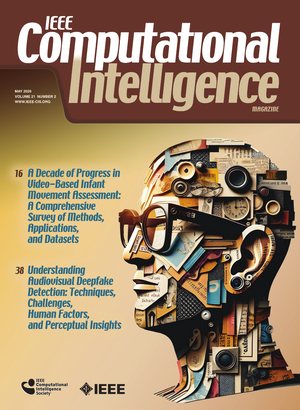 21(2)2026.05From Algorithm-Centric to Reliability-Centric IntelligenceIEEE CIM 21(2) · May 2026 · Full text · IEEE XploreCoverInspired by Giuseppe Arcimboldo's Vertumnus (Italy, 1591, oil on panel, 70 × 58 cm, Skokloster Castle, Sweden). The original builds an emperor's portrait out of fruit and vegetables; the cover builds a face out of paper scraps, lenses and gears. Structure must be pieced together from uncertain, imbalanced and privacy-bound fragments, and intelligence must be reliable before it can be trusted.
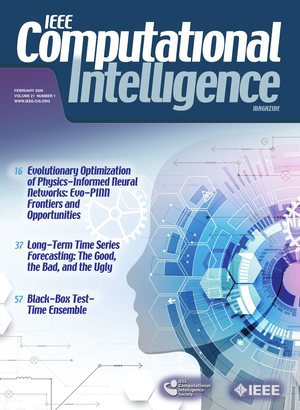 21(1)2026.02Computational Intelligence, Beyond ScaleIEEE CIM 21(1) · Feb 2026 · Full text · IEEE XploreCoverWith thanks to the previous Editor-in-Chief for the cover design.
News
- 2026Invited to serve as Area Chair for ICML 2027 and Senior Program Committee member for IJCAI 2027.
- 2026.08IEEE TEVC special issue Evolutionary Computation Meets Large Language Models, co-guest-edited, published in Vol. 30, No. 4.
- 2026One paper accepted at NeurIPS 2026; serving as NeurIPS 2026 Area Chair.
- 2026One paper accepted at ICLR 2026 and four at AAAI 2026, one of them an oral.
- 2026.01Became Editor-in-Chief of IEEE Computational Intelligence Magazine.
Selected Publications
Featured
- Transfer Learning-Based Dynamic Multiobjective Optimization AlgorithmsM. Jiang*, Z. Huang, L. Qiu, W. Huang, G. G. Yen · IEEE TEVC 2018A transfer-learning framework for dynamic multiobjective optimization.
- Evolutionary Transfer Optimization — A New Frontier in Evolutionary Computation ResearchK. C. Tan, L. Feng, M. Jiang · IEEE Computational Intelligence Magazine 20212024 IEEE CIM Outstanding Paper Award. Lays out evolutionary transfer optimization as a new research direction.
- Transferable Multiform Attack for Cross-Modal Person Re-IdentificationY. Gong†, C. Yang, Q. Zeng, D. Xu, Z. Luo, Z. Wang, M. Jiang* · NeurIPS 2026
- VisionLaw: Inferring Interpretable Intrinsic Dynamics from Visual Observations via Bilevel OptimizationJ. Lin†, S. Jiang, Q. Zeng, Z. Wang, M. Jiang* · ICLR 2026Infers interpretable physical laws from video through bilevel optimization.
- PEGNet: A Physics-Embedded Graph Network for Long-Term Stable Multiphysics SimulationC. Yang†, Z. Wang, J. Liu, Y. Gong, M. Jiang* · AAAI 2026Embeds physical constraints in a graph network for stable long-horizon multiphysics simulation.
All papers in top venues
Papers in CCF-A conferences (the top tier of the China Computer Federation ranking) and leading journals of the field. † first author is a student in the lab * corresponding author All 178 papers →
All · Student first author · Conference · Journal
2026
- Transferable Multiform Attack for Cross-Modal Person Re-IdentificationY. Gong†, C. Yang, Q. Zeng, D. Xu, Z. Luo, Z. Wang, M. Jiang* · NeurIPS 2026
- VisionLaw: Inferring Interpretable Intrinsic Dynamics from Visual Observations via Bilevel OptimizationJ. Lin†, S. Jiang, Q. Zeng, Z. Wang, M. Jiang* · ICLR 2026
- A Theory-Inspired Framework for Few-Shot Cross-Modal Sketch Person Re-IdentificationY. Gong†, Y. Hou, J. Shi, K. L. Diep, M. Jiang* · AAAI 2026, oral
- PEGNet: A Physics-Embedded Graph Network for Long-Term Stable Multiphysics SimulationC. Yang†, Z. Wang, J. Liu, Y. Gong, M. Jiang* · AAAI 2026
- Cross-Field Interface-Aware Neural Operators for Multiphase Flow SimulationZ. Wang†, X. Zhang, J. Liao, M. Jiang* · AAAI 2026
- Fading the Digital Ink: A Universal Black-Box Attack Framework for 3DGS Watermarking SystemsQ. Zeng†, S. Jiang, J. Lin, Z. Wang, K. C. Tan, M. Jiang* · AAAI 2026
- Symbolic Regression with Physics-Informed Residual and Structural Sensitivity PruningY. Gong†, C. Liu, S. Lan, J. Liao, C. Yang, J. Lin, M. Jiang*, G. G. Yen · IEEE TEVC
- Enhancing Generalization and Scalability for Multiobjective Optimization with Population Pre-trainingH. Hong†, L. Feng, M. Jiang, K. C. Tan · Evolutionary Computation
2025
- Phys4DGen: Physics-Compliant 4D Generation with Multi-Material Composition PerceptionJ. Lin†, Z. Wang, D. Xu, S. Jiang, Y. Gong, M. Jiang* · ACM MM 2025
- Interpretable Solutions for Multi-Physics PDEs Using T-NNGPL. Cao†, Z. Lin, K. C. Tan, M. Jiang* · AAAI 2025
- Multispace Dimensionality Reduction Based on Extreme Learning Machine-Assisted Autoencoder for High-Dimensional Expensive OptimizationZ. Wu, W. Song, H. Yu, Y. Guo, M. Jiang, S. Yang · IEEE TEVC
- Gradient-Guided Joint Representation Loss with Adaptive Neck for Train Crash DetectionY. Wen, P. Xu, M. Jiang, W. Xu, C. Yang · IEEE TITS
- Cross-Modality Average Precision Optimization for Visible Thermal Person Re-IdentificationY. Ling, Z. Luo, D. Lin, S. Li, M. Jiang, N. Sebe, Z. Zhong · Pattern Recognition
2024
- Cross-Modality Perturbation Synergy Attack for Person Re-identificationY. Gong†, Z. Zhong, Y. Qu, Z. Luo, R. Ji, M. Jiang* · NeurIPS 2024
- Ask, Attend, Attack: An Effective Decision-Based Black-Box Targeted Attack for Image-to-Text ModelsQ. Zeng†, Z. Wang, Y. Cheung, M. Jiang* · NeurIPS 2024
- An Interpretable Approach to the Solutions of High-Dimensional Partial Differential EquationsL. Cao†, Y. Liu, Z. Wang, D. Xu, K. Ye, K. C. Tan, M. Jiang* · AAAI 2024
- Generating Diagnostic and Actionable Explanations for Fair Graph Neural NetworksZ. Wang†, Q. Zeng, W. Lin, M. Jiang, K. C. Tan · AAAI 2024
- Evolutionary Multitask Optimization with Lower Confidence Bound-Based Solution Selection StrategyZ. Wang†, L. Cao, L. Feng, M. Jiang*, K. C. Tan · IEEE TEVC
- Spatial-Temporal Knowledge Transfer for Dynamic Constrained Multiobjective OptimizationZ. Wang†, D. Xu, M. Jiang*, K. C. Tan · IEEE TEVC
- Multiview Subgraph Neural Networks: Self-Supervised Learning with Scarce Labeled DataZ. Wang†, Q. Zeng, W. Lin, M. Jiang, K. C. Tan · IEEE TNNLS
- An Efficient Dynamic Resource Allocation Framework for Evolutionary Bilevel OptimizationD. Xu†, K. Ye, Z. Zheng, T. Zhou, G. G. Yen, M. Jiang* · IEEE TCYB
- Learning-Based Directional Improvement Prediction for Dynamic Multiobjective OptimizationY. Ye, S. Liu, J. Zhou, Q. Lin, M. Jiang, K. C. Tan · IEEE TEVC
- Dynamic Multiobjective Evolutionary Optimization via Knowledge Transfer and MaintenanceQ. Lin, Y. Ye, L. Ma, M. Jiang, K. C. Tan · IEEE TSMC: Systems
- Transformer-Based Network with Temporal Depthwise Convolutions for sEMG RecognitionZ. Wang, J. Yao, M. Xu, M. Jiang, J. Su · Pattern Recognition
2023
- Robust Graph Meta-learning via Manifold Calibration with Proxy SubgraphsZ. Wang†, L. Cao, W. Lin, M. Jiang, K. C. Tan · AAAI 2023
- Improving Performance Insensitivity of Large-Scale Multiobjective Optimization via Monte Carlo Tree SearchH. Hong†, M. Jiang*, G. G. Yen · IEEE TCYB
- An Evolutionary Multitasking Algorithm with Multiple Filtering for High-Dimensional Feature SelectionL. Li, M. Xuan, Q. Lin, M. Jiang, Z. Ming, K. C. Tan · IEEE TEVC
- Dual-Stream Transformer with Distribution Alignment for Visible-Infrared Person Re-IdentificationZ. Chai, Y. Ling, Z. Luo, D. Lin, M. Jiang, S. Li · IEEE TCSVT
2022
- An Online Prediction Approach Based on Incremental Support Vector Machine for Dynamic Multiobjective OptimizationD. Xu†, M. Jiang*, W. Hu, S. Li, R. Pan, G. G. Yen · IEEE TEVC
- A Knowledge Guided Transfer Strategy for Evolutionary Dynamic Multiobjective OptimizationY. Guo, G. Chen, M. Jiang, D. Gong, J. Liang · IEEE TEVC
- Reducing Negative Transfer Learning via Clustering for Dynamic Multiobjective OptimizationJ. Li, T. Sun, Q. Lin, M. Jiang, K. C. Tan · IEEE TEVC
- WalkGAN: Network Representation Learning with Sequence-Based Generative Adversarial NetworksT. Jin, X. Yang, Z. Yu, H. Luo, Y. Zhang, F. Jie, X. Zeng, M. Jiang · IEEE TNNLS
- Fast Multilabel Feature Selection via Global Relevance and Redundancy OptimizationJ. Zhang, Y. Lin, M. Jiang, S. Li, Y. Tang, J. Long, J. Weng, K. C. Tan · IEEE TNNLS
- Learning from Weakly Labeled Data Based on Manifold Regularized Sparse ModelJ. Zhang, S. Li, M. Jiang, K. C. Tan · IEEE TCYB
2021
- Evolutionary Transfer Optimization — A New Frontier in Evolutionary Computation ResearchK. C. Tan, L. Feng, M. Jiang · IEEE Computational Intelligence Magazine2024 IEEE CIM Outstanding Paper Award
- Manifold Interpolation for Large-Scale Multiobjective Optimization via Generative Adversarial NetworksZ. Wang†, H. Hong, K. Ye, G. Zhang, M. Jiang*, K. C. Tan · IEEE TNNLS
- Knee Point-Based Imbalanced Transfer Learning for Dynamic Multiobjective OptimizationM. Jiang, Z. Wang, H. Hong, G. G. Yen · IEEE TEVC
- A Fast Dynamic Evolutionary Multiobjective Algorithm via Manifold Transfer LearningM. Jiang, Z. Wang, L. Qiu, S. Guo, X. Gao, K. C. Tan · IEEE TCYB
- Individual-Based Transfer Learning for Dynamic Multiobjective OptimizationM. Jiang, Z. Wang, S. Guo, X. Gao, K. C. Tan · IEEE TCYB
- Evolutionary Search with Multi-View Prediction for Dynamic Multi-Objective OptimizationW. Zhou, L. Feng, K. C. Tan, M. Jiang, Y. Liu · IEEE TEVC
- Graph-Based Class-Imbalance Learning with Label EnhancementG. Du, J. Zhang, M. Jiang, J. Long, Y. Lin, S. Li, K. C. Tan · IEEE TNNLS
- Inverse Gaussian Process Modeling for Evolutionary Dynamic Multiobjective OptimizationH. Zhang, J. Ding, M. Jiang, K. C. Tan, T. Chai · IEEE TCYB
- Monodirectional Tissue P Systems with PromotersB. Song, X. Zeng, M. Jiang, M. J. Pérez-Jiménez · IEEE TCYB
2017 – 2020
- Multi-label Feature Selection via Global Relevance and Redundancy OptimizationJ. Zhang, et al., M. Jiang · IJCAI 2020
- A Mixture-of-Experts Prediction Framework for Evolutionary Dynamic Multiobjective OptimizationR. Rambabu, P. Vadakkepat, K. C. Tan, M. Jiang · IEEE TCYB 2020
- Clustering Passenger Trip Data for the Potential Passenger Investigation and Line Design of Customized Commuter BusG. Qiu, R. Song, S. He, W. Xu, M. Jiang · IEEE TITS 2019
- Transfer Learning-Based Dynamic Multiobjective Optimization AlgorithmsM. Jiang*, Z. Huang, L. Qiu, W. Huang, G. G. Yen · IEEE TEVC 2018
- Integration of Global and Local Metrics for Domain Adaptation Learning via Dimensionality ReductionM. Jiang, W. Huang, Z. Huang, G. G. Yen · IEEE TCYB 2017
Honors
- 2024IEEE Computational Intelligence Magazine Outstanding Paper Award
- 2023–26World's Top 2% Scientists (Stanford University / Elsevier)
- 2019Wu Wenjun AI Science and Technology Award (Natural Science), Chinese Association for Artificial Intelligence
- 2019Publons Top Peer Reviewer Award (Computer Science)
- 2016IEEE CIS Outstanding Chapter Award (as Chair, Xiamen Chapter)
- 2016Outstanding Reviewer Award, IEEE Transactions on Cybernetics
Service
- Editor-in-ChiefIEEE CIM2026–
- Assoc. EditorIEEE TEVC2023–
- Assoc. EditorIEEE CIM2022–2025
- Assoc. EditorIEEE TNNLS2020–2025
- Assoc. EditorIEEE TCDS2018–2023, 2025
- AC / SPCIJCAI · NeurIPS · ICML2024, 2026, 2027
- Guest Editor3 special issues2017, 2018, 2026
- ChairIEEE CIS ISA TC2019–2020
- Founding ChairIEEE CIS Xiamen Chapter2013–
Full list and earlier service
- 2026–Editor-in-Chief, IEEE Computational Intelligence Magazine
- 2023–Associate Editor, IEEE Transactions on Evolutionary Computation
- 2027Area Chair, ICML 2027
- 2027Senior Program Committee member, IJCAI 2027
- 2026Area Chair, NeurIPS 2026
- 2026Guest Editor, IEEE TEVC special issue Evolutionary Computation Meets Large Language Models
- 2024Area Chair, IJCAI 2024
- 2022–25Associate Editor, IEEE Computational Intelligence Magazine
- 2020–25Associate Editor, IEEE Transactions on Neural Networks and Learning Systems
- 2018–25Associate Editor, IEEE Transactions on Cognitive and Developmental Systems (2018–2023, 2025)
- 2019–20Chair, IEEE CIS Intelligent Systems and Applications Technical Committee
- 2013–Founding Chair, IEEE CIS Xiamen Chapter
- Lead Guest Editor, IEEE Systems Journal special issue on Human-like Intelligence and Robotics (2017)
- Guest Editor, International Journal of Distributed Sensor Networks special issue on Advances in Industrial Wireless Sensor Networks (2018)
- Program Chair, IEEE CIS–Xiamen University Summer School on Computational Optimization and Learning (2019)
- Organizing Committee Co-Chair, ICACI 2018; Publicity Chair, IEEE WCCI 2016
- Special session organizer, IEEE WCCI 2016 and ICIRA 2015 (knowledge and skill transfer)
- General Chair, MIND 2025
- Vice Chair, IEEE CIS Social Media Subcommittee (2013–2018); member, IEEE CIS Chapters Subcommittee (2015–2017)
- Member, IEEE CIS Emergent Technologies Technical Committee and Task Force on Towards Human-like Intelligence; CCF Technical Committee on Theoretical Computer Science
- Council member, Fujian Association for Artificial Intelligence
- Program Committee member: AAAI, CEC, ICONIP, ISNN, ICACI, IEEE CIHLI, NCTCS and others (2011–2019)
Prospective Students
The Machine Evolution and Learning Lab takes master's and PhD students and postdoctoral researchers, and welcomes undergraduates who want research experience.
- Topics
- Dynamic multiobjective optimization, learning-driven evolutionary computation, large language models and optimization, AI for Science and differentiable simulation, and AI for engineering decisions.
- Supervision
- Newcomers get regular group meetings, one-on-one discussions and detailed feedback on experiment design and paper writing. As students grow, they are encouraged to choose their own problems and lead their own projects.
- Background
- Solid mathematics (linear algebra, probability, calculus), fluency in Python or MATLAB, and a basic grounding in machine learning or evolutionary computation. Above all: curiosity, persistence and academic integrity.
- How to apply
- Use the email subject “Application – Your Name – Master's / PhD / Postdoc”. In the email, give your university and major, the research topic that interests you, and your background and research experience, and attach your CV and transcripts. See the admissions guide for details.